

Choosing a handcrafted copper or solid brass kitchen sink involves more than deciding which material or finish looks best.
Installation type, sink dimensions, cabinet compatibility, bowl depth, gauge, surface and finish all influence how the piece should be fabricated and how it will integrate into the kitchen.
For a handcrafted sink, these decisions are especially important before cabinetry and countertop fabrication are finalized.
Monte Grande manufactures copper and solid brass kitchen sinks by hand in Santa Clara del Cobre, Mexico, offering both existing configurations and custom fabrication for projects that require specific dimensions, finishes or details.
This guide covers the principal decisions to consider before selecting a sink.
Choose the Installation Type
Installation affects not only the appearance of the sink, but also countertop preparation, cabinetry and structural support.
Undermount
An undermount sink is installed beneath the countertop, leaving the countertop edge visible around the basin.
This creates a clean visual transition and works particularly well when the countertop material is intended to remain visually continuous.
Because handcrafted copper and brass sinks can have substantial weight, the sink should be properly supported by the cabinetry rather than relying exclusively on adhesive or the countertop itself.
Farmhouse or Apron-Front
A farmhouse sink extends toward the front of the cabinetry, leaving the apron visible as part of the kitchen design.
Copper and brass are particularly expressive in this format because the front surface becomes an architectural element rather than remaining hidden below the countertop.
Important dimensions include:
- Overall sink width.
- Bowl depth.
- Apron height.
- Cabinet width.
- Countertop opening.
- Space required for support and plumbing.
The cabinetry should be planned around the actual dimensions of the sink.
Drop-In
A drop-in sink is installed from above, with its rim resting on the countertop.
This can simplify certain aspects of installation, although the final countertop opening should still be confirmed against the actual handcrafted sink or approved project dimensions.
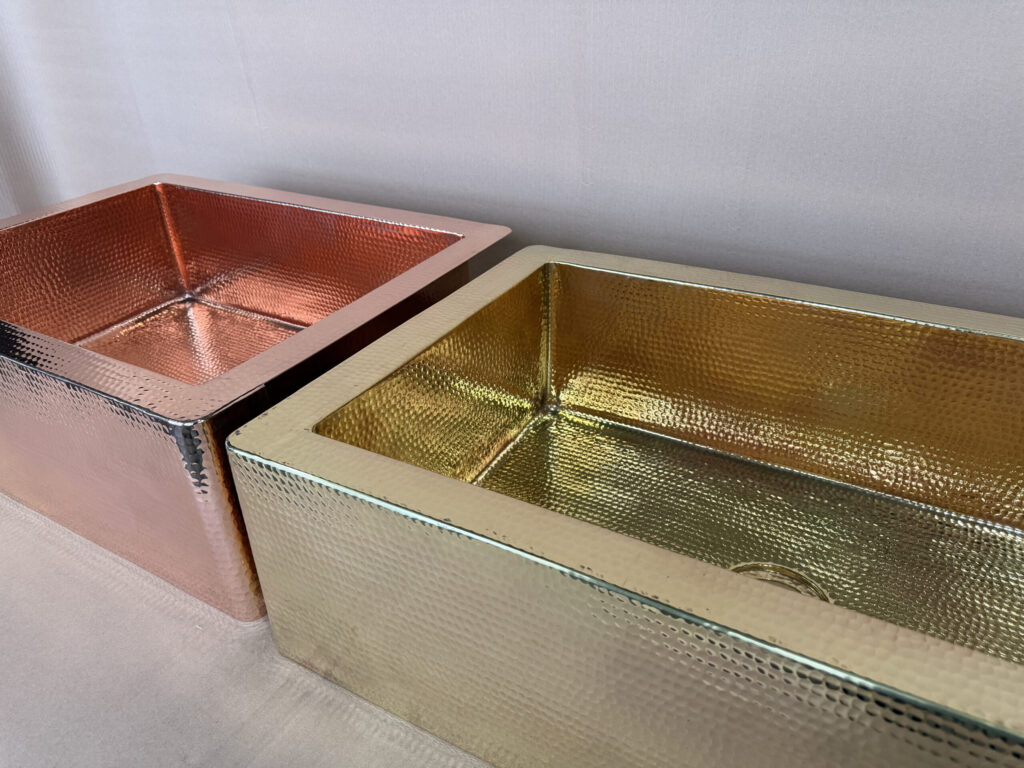
Confirm the Sink Size and Cabinet Compatibility
A sink can appear correctly proportioned in a photograph while still being unsuitable for the cabinetry or countertop planned for a particular project.
For that reason, the nominal width alone is not enough.
Overall Sink Dimensions
Overall dimensions describe the total external width, front-to-back measurement and height of the piece.
They determine how much physical space the complete sink requires.
Common Kitchen Sink Sizes
Monte Grande currently offers several standard size configurations across its copper and solid brass kitchen sink collections:
- 30″ × 22″ × 9″
- 30″ × 22″ × 10″
- 33″ × 22″ × 9″
- 33″ × 22″ × 10″
- 36″ × 22″ × 9″
- 36″ × 22″ × 10″
- 42″ × 22″ × 9″
- 42″ × 22″ × 10″
These measurements are expressed as overall width × front-to-back dimension × nominal depth.
Across these configurations, the front-to-back dimension remains 22 inches, while the overall width ranges from 30 to 42 inches and the nominal depth can be either 9 or 10 inches.
The appropriate size depends on the available cabinet space, installation type, desired bowl capacity and the proportions of the surrounding countertop.
A larger sink is not automatically the better choice. It should remain appropriately scaled to the cabinetry and to the way the kitchen will be used.
Monte Grande’s current kitchen sink product configurations show these standard size combinations across several copper and brass models.
Overall Size vs. Usable Bowl Dimensions
The listed sink size refers to the overall dimensions of the piece. The usable interior dimensions can be smaller depending on rim construction, workstation ledges, apron design and other fabrication details.
For example, in a 30″ × 22″ × 9″ farmhouse workstation configuration, the dimensions can be specified as:
- Outside dimensions: 30″ × 22″ × 9″
- Inside dimensions including ledges: 26″ × 18″ × 9″
- Inside dimensions excluding ledges: 26″ × 16″ × 9″
- Workstation ledges: 1″ on each side
- Apron front: 30″ × 9.5″
This illustrates why the nominal product size should not be used by itself to determine either the usable bowl space or the countertop opening.
Workstation ledges and other fabrication details can change the internal dimensions even when the overall sink dimensions remain the same.
Bowl Dimensions
Bowl dimensions describe the usable interior of the sink.
Two sinks with similar overall dimensions can have different usable bowl dimensions depending on rim construction, corner geometry and wall shape.
Bowl Depth
Bowl depth affects capacity, ergonomics and the amount of vertical space required below the countertop.
A deeper basin can provide additional space for cookware, but also needs to be considered in relation to cabinetry, plumbing and drain clearance.
Minimum Cabinet Size
The cabinet needs enough space for more than the basin itself.
The complete installation may need to accommodate:
- The sink.
- Structural support.
- Drain components.
- Plumbing.
- Faucet clearances.
- Workstation details, when applicable.
A sink and cabinet with the same nominal width should not automatically be assumed to be compatible.
Apron Height
For farmhouse sinks, apron height needs to coordinate with the front of the cabinet.
This is one of the dimensions that should be established before cabinetry is completed.
Confirm the Actual Sink Before Cutting the Countertop
A handcrafted piece should not be approached exactly like a mass-produced component with identical dimensions from one unit to another.
Whenever possible, final countertop fabrication should be based on the actual finished sink or on dimensions specifically approved for the project.
This helps account for the individual characteristics of a handmade piece and reduces unnecessary complications during installation.
Space for plumbing and structural support should also be confirmed before the countertop is permanently fabricated.
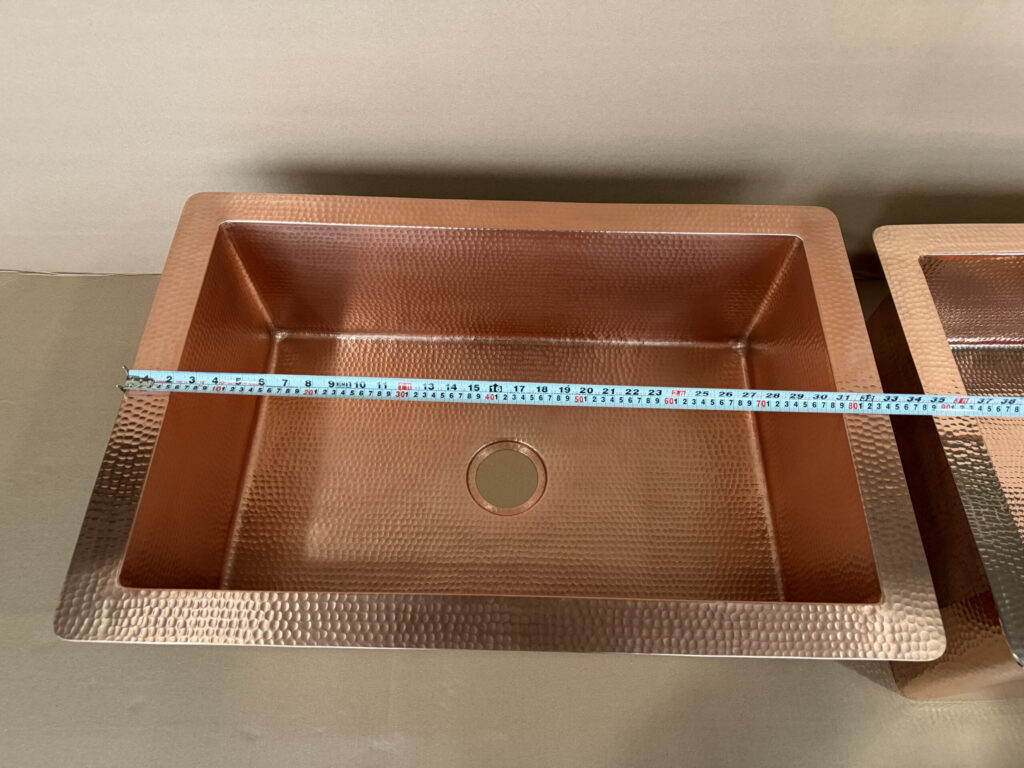
Understand Copper and Brass Gauge
Gauge refers to the nominal thickness of the sheet metal used to fabricate the sink.
An important point is that gauge numbers work in reverse:
A lower gauge number represents a thicker sheet.
For the sheet specifications used in Monte Grande kitchen sinks, 14 gauge is thicker and heavier than 16 gauge.
However, gauge should not be evaluated in isolation.
The structure and character of a handcrafted sink also depend on:
- Overall dimensions.
- Bowl depth.
- Geometry.
- Corner design.
- Forming.
- Hammering.
- Welding.
- Rim construction.
- Material.
- Installation and support.
Monte Grande commonly uses 16 gauge for kitchen sinks.
A thicker 14-gauge construction can be selected when the complete design benefits from additional material mass or rigidity, particularly in some oversized pieces, or simply when a client prefers a heavier construction.
That does not mean that 14 gauge is universally better.
A properly designed and fabricated 16-gauge sink remains a substantial premium specification.
For a detailed comparison, see 14 vs. 16 Gauge Kitchen Sinks: Understanding Copper and Brass Thickness.
Choose the Surface
The surface treatment changes how light, texture and natural variations appear across the metal.
Hammered Surface
A hammered sink provides greater visual texture and a more irregular reflection of light.
Because the surface itself contains visible variation, some marks created through ordinary use may also appear less prominent than they would on a perfectly smooth surface.
The hammering is part of the handmade character of the piece and should not appear mechanically identical from one area to another.
Smooth Surface
A smooth surface creates a cleaner and more contemporary appearance.
With less physical texture, tonal changes, water marks and other natural surface variations may be more visible.
Choosing between hammered and smooth therefore affects both the original appearance of the sink and how its changing surface is perceived over time.
Understand Living and Sealed Finishes
Copper and brass respond naturally to their environment.
Air, water, touch, cleaning products and everyday use can all influence how the surface develops.
Living Finish
A living finish is expected to evolve.
Its color and patina can deepen, soften or develop tonal variation as the metal interacts with the surrounding environment.
With unsealed copper, acidic foods or liquids can temporarily alter the color of the surface.
That change should not automatically be interpreted as damage. Variation is an inherent part of a living material.
For a deeper explanation of this process, see The Beauty of a Living Finish: How Copper Patina Evolves Over Time.
Sealed Finish
A sealed finish includes a protective coating intended to reduce or slow some of the changes normally associated with an unsealed surface.
It can be useful when a project requires greater consistency in the appearance of the selected finish.
However, sealed does not mean permanently unchangeable.
Coatings can still be affected by abrasive products, chemicals, scratches, heat and ordinary wear, and they require care methods compatible with the finish.
For long-term care recommendations, refer to Monte Grande’s Copper and Brass Care & Maintenance Guide.
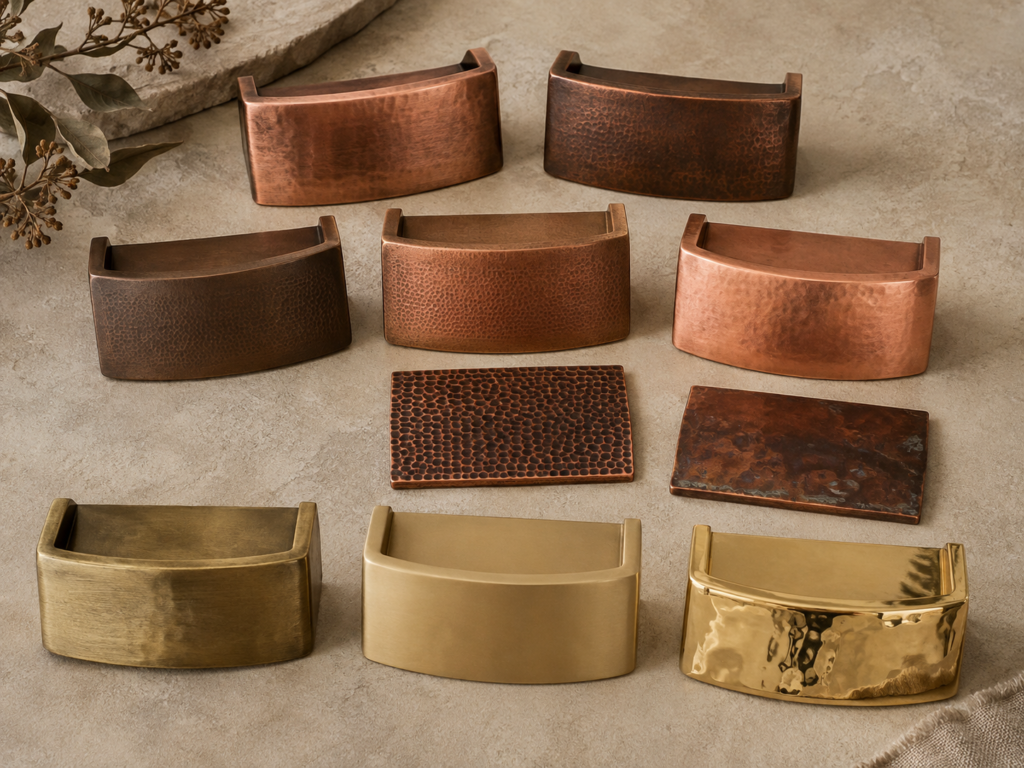
Standard or Custom?
An existing sink design can be the right solution when its dimensions, installation method and finish already correspond to the project.
A custom sink becomes useful when the kitchen requires something more specific.
Depending on the project, custom fabrication can involve:
- Width, length and depth.
- Single- or multi-bowl configurations.
- Drain location.
- Apron dimensions.
- Corner radius.
- Hammered or smooth surfaces.
- Patina or finish.
- Workstation ledges.
- Other fabrication details appropriate to the design.
Custom fabrication is particularly useful when the sink needs to respond to existing cabinetry, a specific countertop layout or architectural requirements that cannot be solved with a standard configuration.
Workstation
A workstation sink incorporates an internal ledge designed to support compatible accessories over the bowl.
When a workstation is fabricated as a custom piece, the ledge dimensions become part of the overall sink geometry and should be considered together with bowl size, depth and intended use.
Information to Prepare for a Custom Sink
When discussing a custom kitchen sink, having the following information available helps the workshop understand the project more accurately:
- Desired overall dimensions.
- Installation type.
- Cabinet dimensions.
- Photographs, drawings or plans.
- Preferred drain location.
- Hammered or smooth surface preference.
- Finish or patina preference.
- Approximate project schedule.
Not every detail needs to be finalized before the first conversation, but accurate dimensions and project information make it easier to identify the decisions that still need to be resolved before fabrication.
Final Kitchen Sink Checklist
Before confirming a copper or brass kitchen sink, review:
- Installation type.
- Cabinet dimensions.
- Overall sink dimensions.
- Bowl dimensions.
- Bowl depth.
- Drain location.
- Gauge.
- Hammered or smooth surface.
- Living or sealed finish.
- Standard or custom requirements.
Choosing the Sink as Part of the Complete Kitchen
The right copper or brass kitchen sink is not defined by a single specification.
Installation type, cabinet dimensions, bowl proportions, gauge, surface, finish and fabrication all need to work together.
For a handcrafted piece, planning these details before the countertop is cut helps create a more considered result and reduces avoidable complications during installation.
Whether the final choice is an existing configuration or a sink developed specifically for the project, the best decisions come from understanding how the piece will be fabricated, supported and used over time.
