

Custom copper surfaces are rarely defined by material alone.
A countertop, bar top or tabletop may all begin with copper, but the final result depends on a combination of construction, dimensions, substrate, edge profile, texture, patina, intended use and installation conditions.
For residential projects, these decisions often determine how the piece feels within the room. For hospitality and commercial interiors, they also influence fabrication strategy, transportation, installation and long-term maintenance.
Understanding these elements before placing an order makes it easier to move from a visual idea to a surface that can actually be fabricated, shipped and installed correctly.
AT A GLANCE
Before ordering a custom copper surface, define:
Dimensions · Thickness · Edge Profile · Texture · Patina · Intended Use · Installation Conditions · Delivery Location
How Custom Copper Surfaces Are Built
At Monte Grande, custom copper countertops, bar tops and tabletops are typically constructed by wrapping copper around a structural plywood core.
The copper provides the visible surface, texture and finish, while the plywood creates the structural body of the piece.
This construction method makes it possible to produce substantial surfaces that retain the visual richness of handcrafted copper while providing a stable base for installation.
Why the Substrate Matters
The material underneath the copper is an important part of the finished product.
A quality plywood substrate provides rigidity, dimensional stability and a substantial feel. It also gives installers a familiar material to work with when attaching the finished surface to cabinetry or other supporting structures.
Other construction methods can use lighter or less substantial cores, including MDF or alternative internal structures. These can reduce weight or cost in certain applications, but they do not necessarily provide the same rigidity or physical character.
For Monte Grande, the plywood core is part of the overall construction philosophy:
The surface should not only look substantial—it should feel substantial as well.
This construction system can be adapted for:
- kitchen countertops;
- residential bar tops;
- commercial bar surfaces;
- dining tabletops;
- hospitality surfaces;
- custom furniture;
- architectural applications.
CONSTRUCTION NOTE
The visible copper is only one part of the finished surface.
The quality and rigidity of the substrate directly influence how substantial the completed piece feels and how it behaves during installation.
Dimensions, Shapes & Edge Profiles
One of the main advantages of custom copper fabrication is that the surface is not limited to standard retail dimensions.
Monte Grande can work with a wide range of custom lengths and widths depending on the requirements of the project.
Thickness
Typical finished thicknesses range from approximately:
1 inch to 3 inches
However, thicker profiles can be fabricated when the design requires a more substantial architectural presence.
The apparent thickness of the finished piece should be considered together with the cabinetry, base and proportions of the surrounding space.
Straight and Decorative Edges
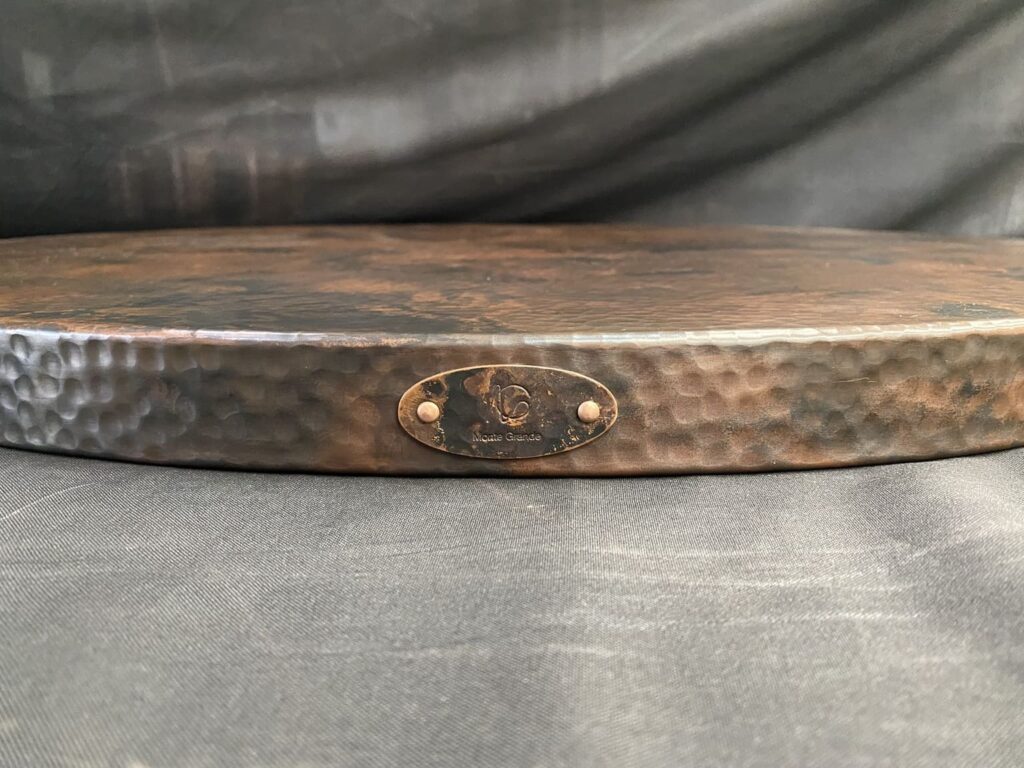
A clean 90-degree edge creates a simple, architectural perimeter that works particularly well in contemporary interiors.
For projects that require more visual character, custom edge profiles can also be developed.
These details may appear subtle in drawings, but they strongly influence how the final surface reads once installed.
Corner Radius
Standard square and rectangular Monte Grande tables generally use defined 90-degree corners.
For custom projects, however, different corner radii can be incorporated depending on the design intent.
Rounded corners may be appropriate for:
- curved cabinetry;
- hospitality environments;
- circulation areas;
- softer furniture geometries;
- custom bars and service counters.
Oversized and Irregular Pieces
Unusual geometries can also be developed.
For irregular shapes, oversized surfaces or pieces with multiple radii, a reference image, drawing or simple sketch is especially helpful.
The drawing does not necessarily need to be a fully developed architectural document at the beginning of the conversation.
Even a clear visual reference with dimensions can help the workshop understand the intended geometry and identify the information required for fabrication.
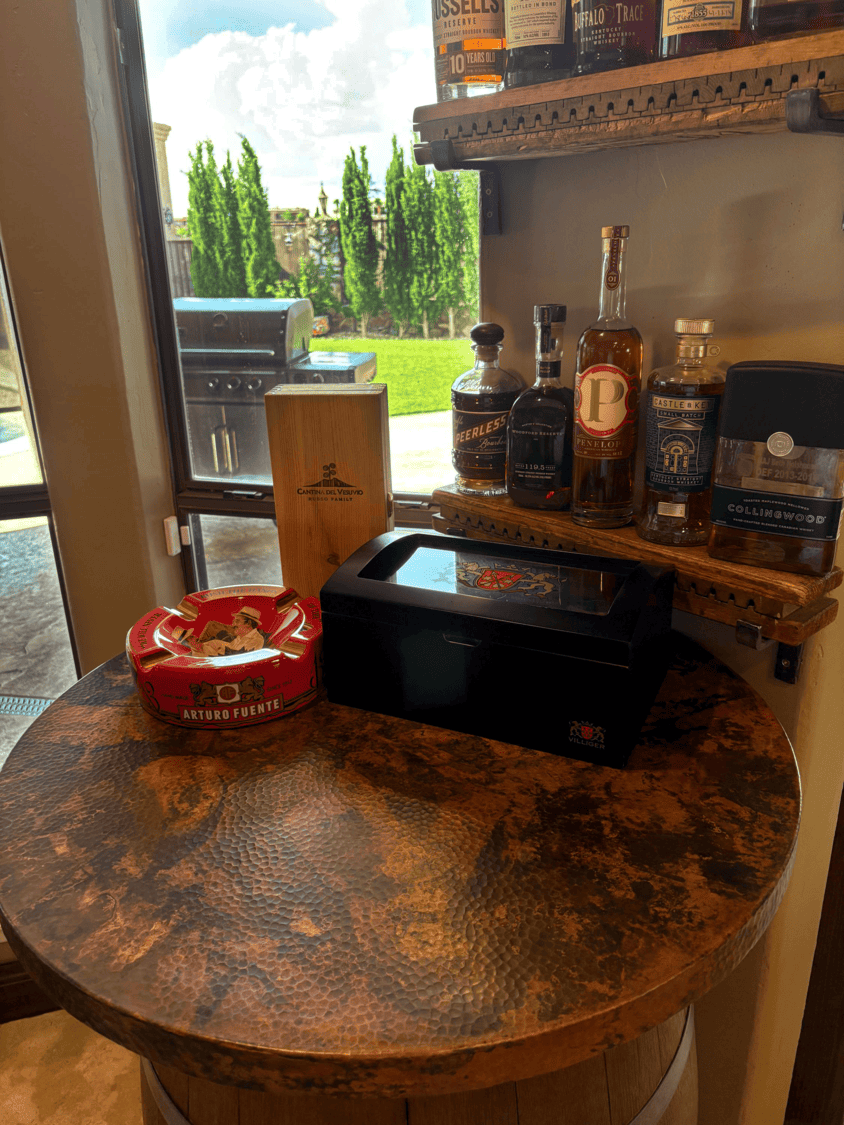
Surface Texture & Patina
Texture changes both the appearance of copper and the way the surface behaves visually over time.
The two most common directions are hammered and smooth.
Hammered Copper Countertops
A hammered copper countertop has a visibly handcrafted texture created through repeated surface work.
Beyond its decorative character, hammering has a practical visual advantage: the texture can make everyday marks, small tonal changes and subtle surface variations less noticeable.
This makes hammered copper particularly well suited to surfaces where the client wants a strong handmade character.
The hammering should still be controlled carefully. A working surface must remain functional for glasses, dishes, bottles and other objects placed on it.
Texture without compromising usability.
Smooth Copper Surfaces
Smooth copper creates a cleaner and more contemporary appearance.
Because the surface is more visually continuous, however, fingerprints, water marks, tonal variation and minor imperfections may become more apparent.
This is not a functional problem. It is simply part of how a smooth metal surface responds to light and use.
Both hammered and smooth copper can be fully functional choices.
HAMMERED vs. SMOOTH
HAMMERED
Visual character
More visibly handcrafted and textural.
Everyday use
Texture helps soften the appearance of small marks and tonal changes.
Light
Creates more variation, depth and movement across the surface.
Best suited for
Projects seeking a strong artisanal character.
SMOOTH
Visual character
Cleaner and more contemporary.
Everyday use
Marks and tonal changes can be more noticeable.
Light
Creates a more continuous and reflective visual surface.
Best suited for
Projects seeking a restrained, modern material expression.
Choosing a Copper Patina
Patina determines the starting color and tonal character of the copper.
Depending on the project, the surface can be developed with warm copper tones, darker brown finishes or more complex aged appearances.
Because patinas are applied by hand, some natural variation should be expected.
That variation is part of what differentiates handcrafted copper from a factory-applied decorative laminate or printed finish.
Lighting also changes how patina reads.
A darker copper surface may appear dramatically different under:
- natural daylight;
- warm restaurant lighting;
- directional architectural lighting;
- bright residential kitchen lighting.
When coordinating copper with stone, wood, cabinetry or hardware, the finish should therefore be considered within the broader material palette.
For a deeper explanation of how copper evolves over time, see our guide to copper patina and living finishes.
Living Finish vs. Protective Clear Coat
One of the most important decisions when ordering a custom copper countertop or bar top is whether the metal should remain a living finish or receive a protective coating.
LIVING FINISH
Uncoated copper naturally responds to touch, moisture, oils, air, cleaning, and food and beverage exposure.
Over time, the surface may darken, lighten or develop new tonal variation.
For many clients, this evolution is part of the appeal of copper. The material records use and develops character rather than remaining visually static.
Best suited for:
Clients who value natural aging, tonal variation and the evolving character of copper.
PROTECTIVE CLEAR COAT
Special protective lacquers can be applied when the goal is to preserve the original appearance for a longer period.
A protective clear coat can reduce direct interaction with the environment, simplify routine maintenance, help preserve the initial patina and slow natural surface change.
This can be particularly valuable for clients who prefer a more predictable appearance.
Best suited for:
Clients who prioritize finish consistency, easier maintenance and less visible natural aging.
KEY DECISION
Neither approach is inherently better.
The correct choice depends on what the client expects the surface to look like several years after installation.
For bars and other high-use surfaces, a protective finish may be particularly useful when maintaining the original appearance is a priority.
Installation & Large-Scale Considerations
Fabrication does not end when the copper surface leaves the workshop.
The supporting structure, cabinetry and installation method should also be considered before production begins.
Cabinetry and Base Compatibility
Because the underside of many Monte Grande countertops and tabletops leaves the plywood substrate accessible, installers can generally approach the piece in a manner similar to working with a wood surface.
This makes the substrate useful during mounting because fasteners can connect with the structural core rather than requiring installers to work directly through the finished copper surface.
INSTALLATION NOTE
Confirm fastener length before installation.
If screws are being used, their length must be selected carefully. A screw that is too long can travel through the substrate and damage or penetrate the finished copper surface.
The finished thickness of the piece and the depth of the available substrate should always be confirmed before choosing fasteners.
Single Pieces vs. Multi-Piece Assemblies
For most residential projects, a countertop or tabletop can usually be fabricated as a single piece because the dimensions remain manageable.
Hospitality and commercial projects can be different.
Long bars, large service counters or architectural surfaces may need to be divided into multiple sections because of:
- fabrication constraints;
- transportation;
- packaging;
- building access;
- installation requirements.
When multiple sections are required, seam locations should be considered intentionally rather than treated as an afterthought.
The Sierra Restaurant project demonstrates how custom copper can be coordinated across multiple separately fabricated surfaces within one hospitality interior.
Packaging & Shipping Custom Copper Surfaces
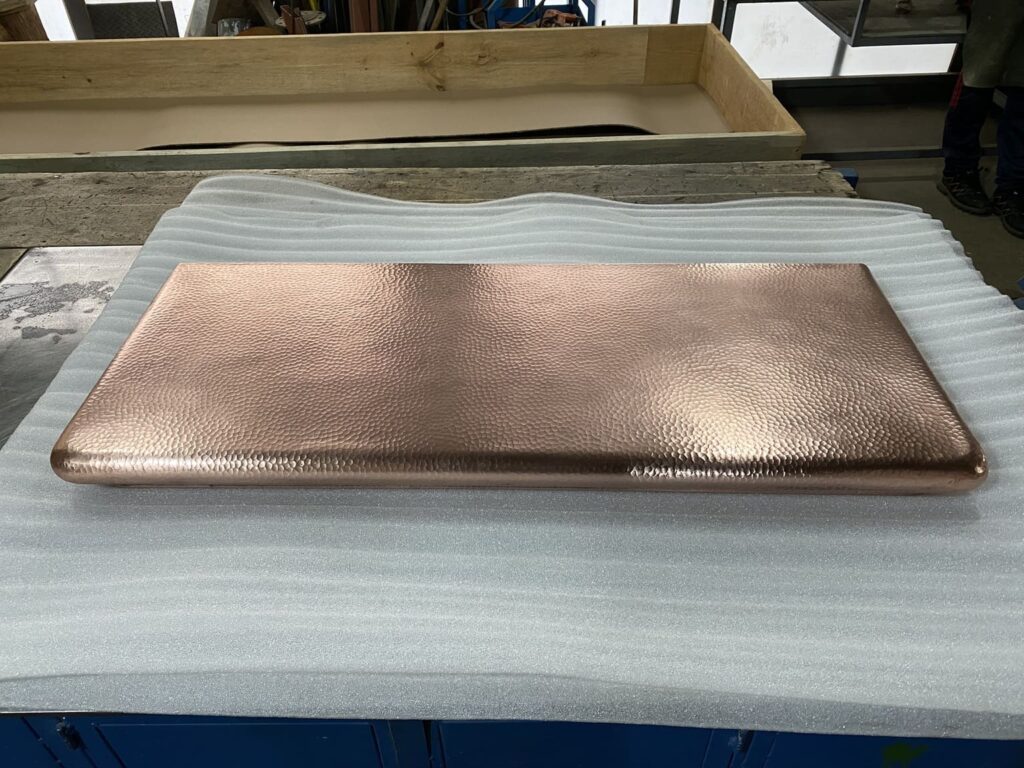
Large handcrafted metal surfaces require more protection than standard parcel-size products.
Packaging strategy depends on:
- dimensions;
- weight;
- geometry;
- finish;
- edge conditions;
- destination;
- number of pieces.
Protecting the patina and edges during transportation is particularly important because large flat surfaces can be more vulnerable to impact than smaller products.
For oversized hospitality packages, shipping and installation planning should therefore form part of the project conversation before fabrication is finalized.
LOGISTICS NOTE
Size affects more than fabrication.
Overall dimensions can also influence:
packaging + transportation + building access + handling + installation strategy
For large projects, these requirements should be reviewed before the final piece enters production.
What to Provide for a Custom Copper Countertop Quote
The more information available at the beginning of a project, the more accurately the workshop can evaluate the piece.
PROJECT INFORMATION CHECKLIST
| Project detail | What to provide |
|---|---|
| Dimensions | Length and width of the surface. |
| Thickness | Desired finished profile. |
| Edge profile | Straight, rounded or another custom condition. |
| Finish / Patina | Preferred color, texture or visual reference. |
| Surface texture | Hammered, smooth or another requested treatment. |
| Intended use | Kitchen countertop, bar, restaurant, tabletop, service counter or another application. |
| Quantity | One individual piece or multiple related surfaces. |
| Delivery location | City, state/region and country help determine logistical requirements. |
| Reference image or drawing | Especially important for unusual geometries, custom corners, oversized surfaces or architectural details. |
A SIMPLE DRAWING CAN BE ENOUGH TO START
For irregular or highly customized pieces, a simple drawing with measurements can often communicate more than a long written description.
The objective at the initial stage is not necessarily to have every fabrication detail resolved.
It is to give the workshop enough information to understand the scope, geometry and intended result.
Custom Copper Surfaces Are a Combination of Decisions
A successful custom copper countertop is not defined by a single specification.
It is the result of coordinating:
DIMENSIONS
Overall size and geometry.
CONSTRUCTION
How the finished surface will be built.
SUBSTRATE
The structural body underneath the copper.
THICKNESS
The visual and physical profile of the piece.
EDGE PROFILE
How the perimeter is shaped and finished.
TEXTURE
Hammered, smooth or another treatment.
PATINA
The starting tonal character of the copper.
PROTECTION
Living finish or protective coating.
INSTALLATION
How the piece relates to cabinetry, bases and fasteners.
INTENDED USE
Residential, hospitality, commercial or another application.
THE KEY PRINCIPLE
These decisions should work together.
A heavily used restaurant bar may require a different finish strategy than a residential island.
An oversized hospitality surface may need different fabrication and shipping considerations than a single tabletop.
A smooth modern surface may require different expectations around visible marks than a deeply handcrafted hammered finish.
The earlier these decisions are considered, the easier it becomes to translate the design idea into a buildable piece.
Planning a Custom Copper Countertop or Bar Top?
Monte Grande develops handcrafted copper surfaces for residential, hospitality and commercial projects, with custom dimensions, textures, patinas and edge conditions.
Whether the project begins with detailed architectural drawings or simply a reference image and dimensions, the objective is the same: translate the design intent into a surface that can be fabricated, transported and installed successfully.
Start a Custom Project and send your dimensions, reference images or drawings to begin the conversation.
