

Hospitality projects rarely depend on a single surface.
At Sierra Restaurant, copper was used across multiple areas of the interior, including dining tables, large-format round tables, service areas, a hostess station, drink rails, bar surfaces and architectural panels.
The challenge was not simply producing each individual piece. It was maintaining a consistent material language across dozens of separately fabricated surfaces while adapting copper to different geometries, dimensions and functional requirements.
The result required close control of hammering, patina, surface level and fabrication details so that the copper could remain visually expressive while still performing as a working commercial surface.
The Scope of the Sierra Restaurant Project
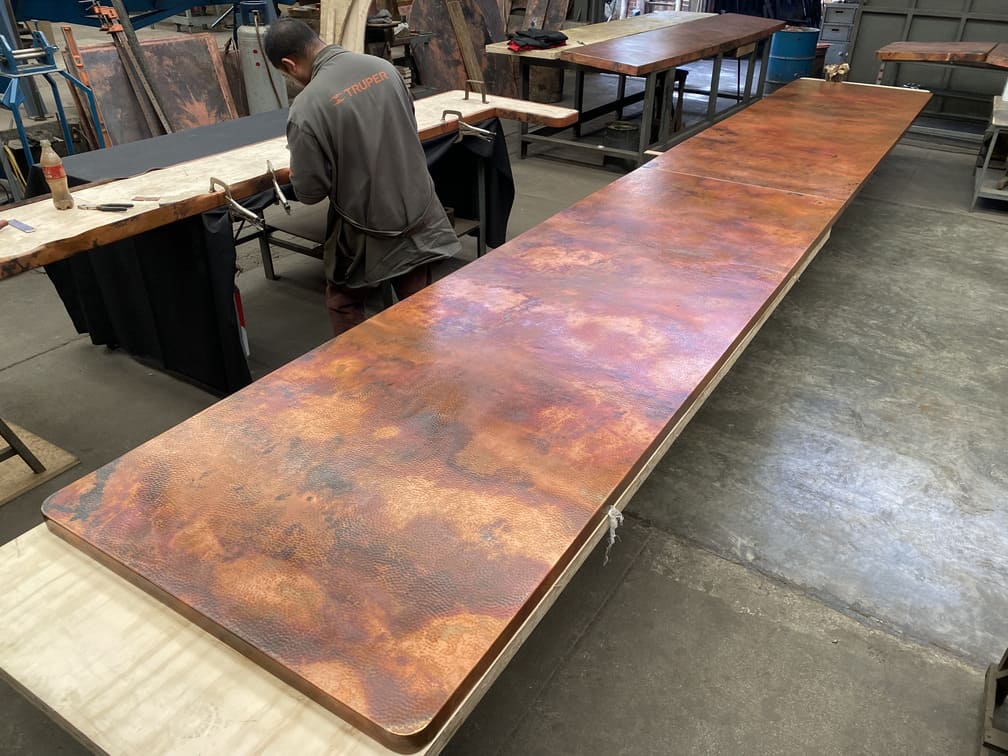
The Sierra Restaurant project involved 53 individual copper surfaces, a five-piece bar assembly and 20 large architectural panels.
This scale introduced a different set of fabrication requirements than a single custom tabletop or residential piece.
Multiple elements needed to work together visually while still being produced individually, packaged separately and coordinated for installation.
Dining surfaces, service areas, architectural panels and bar components also perform different functions, which meant that each piece had to be considered within its specific location rather than treated as part of one repetitive production run.
The project demonstrates how custom copper fabrication can be extended across an entire hospitality interior while maintaining a recognizable and consistent material character.
One Material, Many Geometries
One of the defining aspects of the project was the variety of shapes involved.
The copper surfaces included:
- round tables;
- rectangular surfaces;
- square surfaces;
- pieces with different radii;
- different material thicknesses;
- specialized shapes designed for specific locations.
Working with a single material across multiple geometries requires careful coordination.
A large round dining table behaves differently from a narrow drink rail or an architectural panel. Each piece has different proportions, edge conditions, substrates and fabrication constraints.
Rather than forcing every element into one standard product format, the fabrication process was adapted to the dimensions and purpose of each surface.
Consistency Across a Large Hospitality Project
For a project of this scale, consistency becomes one of the most important technical and visual requirements.
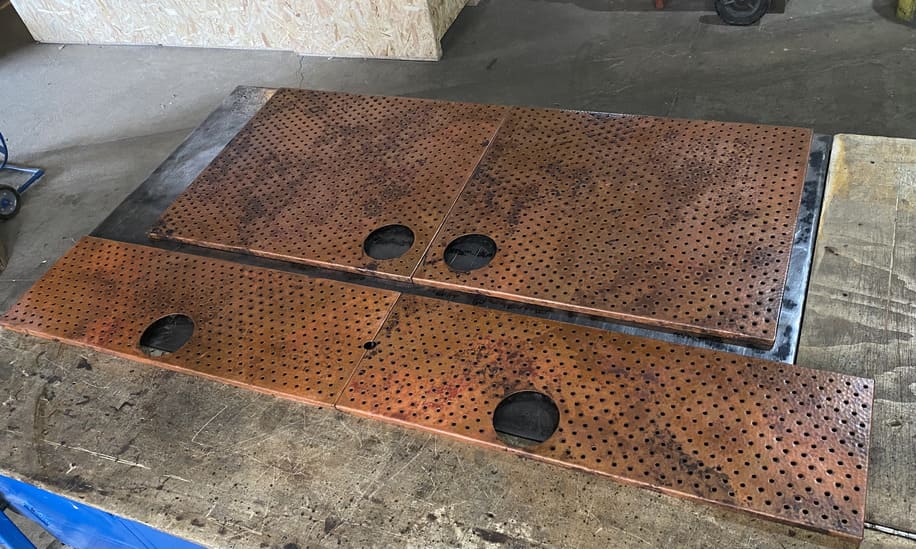
Each copper surface was fabricated separately, but the finished pieces needed to share the same overall hammered character and controlled patina.
That meant managing several variables throughout production:
hammering pattern, texture depth, tonal variation and surface level.
The goal was not to make every piece mechanically identical. Handcrafted copper naturally contains subtle variation.
Instead, the objective was to maintain enough consistency that all of the surfaces would feel part of the same interior once installed.
Hammered Texture Without Compromising Function
Hammering gives copper much of its visual depth and handcrafted character, but hospitality surfaces also need to perform.
Dining tables and bar surfaces must provide sufficient stability for:
- plates;
- glasses;
- wine glasses;
- bottles;
- serving pieces;
- other objects used throughout daily restaurant service.
If the hammered texture becomes too pronounced or inconsistent, the surface can become less practical.
For this reason, the texture had to be controlled carefully so that the copper retained a visible handcrafted pattern while still providing a usable and sufficiently level working surface.
This balance between aesthetic texture and functional stability was particularly important across dining and bar areas.
Controlling the Patina Across Multiple Pieces
Patina was another element that required coordination.
Copper naturally responds to its environment and develops variation over time, but when dozens of pieces are being fabricated for the same commercial interior, the initial finish needs to establish a coherent visual starting point.
The objective was to maintain a controlled patina across the separately fabricated surfaces while preserving the natural material character of copper.
Because each piece reacts individually to fabrication, finishing and handling, achieving visual continuity requires a controlled process rather than simply applying the same treatment once.
The completed surfaces could then enter the restaurant with a coordinated appearance while continuing to develop naturally as part of the interior.
For more information about this behavior, see our article on copper patina and living finishes.
Fabrication for Commercial Use
Commercial interiors introduce practical considerations that go beyond appearance.
Many of the Sierra surfaces were produced using a plywood substrate, giving the copper a stable structural base while allowing large-format pieces to be fabricated for their intended locations.
Fabrication also had to account for:
- dimensions;
- edge conditions;
- large surface areas;
- substrate coordination;
- packaging;
- transportation;
- installation requirements.
Large restaurant surfaces are not simply enlarged versions of residential tabletops.
Their scale changes how pieces must be handled during fabrication, how they are protected during shipment and how installation tolerances need to be considered before production is completed.
The Five-Piece Bar Assembly
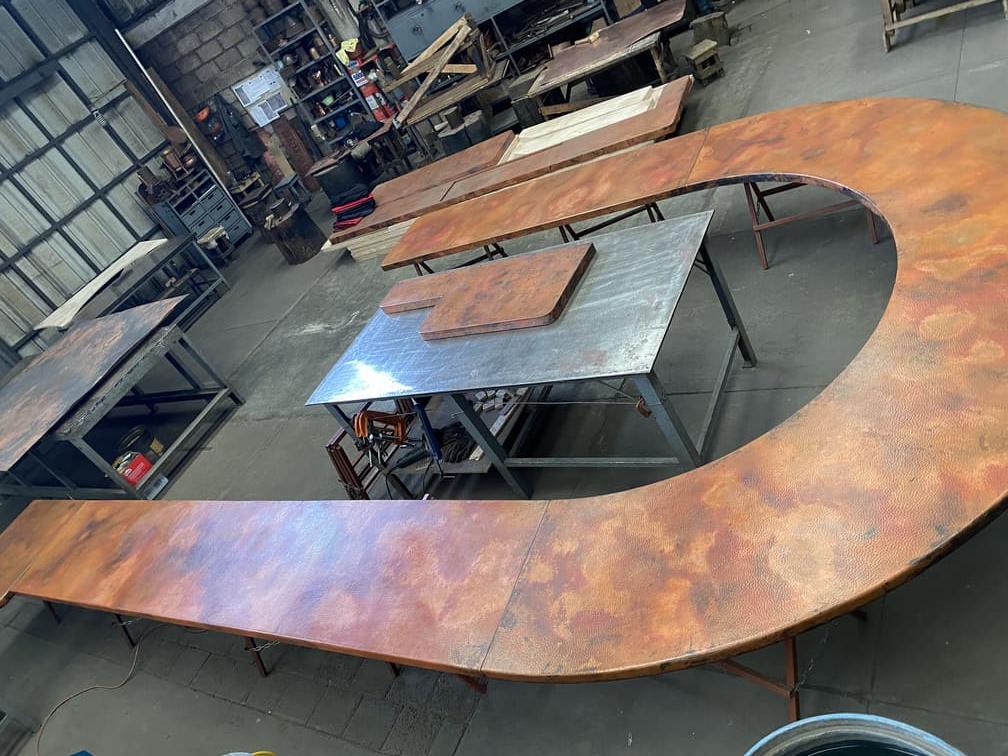
The bar represented one of the most complex elements of the project.
Rather than being fabricated as a single oversized piece, it was produced as a five-piece assembly.
This approach required coordination between the individual copper sections so that the final installation would read as one continuous architectural element.
The fabrication process therefore had to consider not only the finish of each section, but also how adjacent pieces would relate to one another once installed.
For hospitality projects, these junctions, transitions and dimensions need to be resolved early because small discrepancies can become much more visible across long bar surfaces.
Architectural Copper Beyond the Tabletop
Copper was not limited to horizontal work surfaces.
The project also included 20 large architectural panels, allowing the same material to continue vertically through the interior.
Using copper across both furniture-scale elements and architectural surfaces created continuity without requiring every application to look identical.
The material could shift between dining tables, service areas, bar surfaces and wall panels while retaining the same overall hammered character and patina.
That repetition helped copper function as a material thread throughout the project rather than as a decorative accent used in only one location.

From Workshop Fabrication to Final Installation
Projects involving dozens of custom pieces require coordination long before shipping.
Dimensions, drawings, fabrication sequence, finishing, packaging and installation considerations all need to be understood before production begins.
For Sierra, each surface was fabricated as an individual component while remaining part of a larger system.
This type of work reflects Monte Grande’s broader approach to custom copper and brass projects: adapting handcrafted metalwork to the architectural and functional requirements of the project rather than limiting the project to predetermined product dimensions.
Custom Copper Surfaces for Hospitality Interiors
Restaurants, hotels and other hospitality environments often require surfaces that cannot be resolved through standard product dimensions alone.
Bar tops, dining tables, hostess stations, service areas and architectural panels may each have different geometries while still needing to belong to the same design language.
Custom fabrication makes it possible to coordinate:
- dimensions;
- shape;
- substrate;
- hammering;
- patina;
- thickness;
- functional requirements;
- installation considerations.
For projects involving tabletops specifically, explore Monte Grande’s handcrafted copper tabletops.
A Material System, Not a Single Copper Piece
The Sierra Restaurant project demonstrates a different way of thinking about custom copper fabrication.
Instead of designing one isolated object, the project required the same material to perform across 53 individual surfaces, a multi-piece bar and large architectural panels.
The success of a project at this scale depends not only on fabrication skill, but on maintaining control across many separate elements:
geometry, hammering, patina, level surfaces, dimensional coordination and final installation.
When those factors are considered together, copper can move beyond a single feature piece and become part of the architectural language of an entire hospitality interior.
