

Copper is often chosen for the qualities that make it different from more uniform kitchen materials: warmth, depth, variation and the ability to change over time.
Those same qualities influence the way a copper sink should be cleaned.
A handcrafted copper sink does not need an aggressive cleaning routine to remain functional or beautiful. In most cases, simple care is the most appropriate care. Mild soap, warm water and a soft cloth are usually enough to remove everyday residue while allowing the surface to retain its natural character.
The objective is not necessarily to return the copper to the exact appearance it had when it left the workshop. Copper is a living material, and its finish responds to water, air, touch, food and use. Cleaning should remove dirt and residue without treating every variation in color as a defect.
Understanding that distinction makes copper sink care considerably easier.
Understanding the Finish Before You Clean
Before cleaning a copper sink, it is important to understand what kind of finish it has and how that finish is expected to behave.
Some copper sinks are designed with a natural living finish. This means that the surface is expected to darken, lighten and develop subtle variations over time. Water, oils, acidic foods and normal kitchen activity may temporarily affect the color, but these changes often become part of the evolving patina.
Other sinks may have a waxed, sealed or otherwise protected surface intended to preserve a more controlled appearance. These finishes can require different maintenance, especially if the protective layer begins to wear unevenly.
When possible, review the care information provided with the sink before applying any cleaner, polish or treatment. A method that may be appropriate for unfinished copper could affect a sealed or specialty finish differently.
For Monte Grande pieces, the Maintenance Guide provides additional recommendations for caring for handcrafted copper and brass surfaces.
The most important principle is simple: clean according to the finish you have, not according to the appearance you are trying to force the material to maintain.
What You Need for Everyday Copper Sink Care
Routine copper sink care does not require a large collection of products.
For most everyday cleaning, you will need:
- Warm water.
- A mild, non-abrasive dish soap.
- A soft sponge or microfiber cloth.
- A clean, soft towel for drying.
A soft-bristle brush may also be useful for corners, drains or textured hammered surfaces, provided that the bristles are gentle and do not scratch the finish.
Avoid assuming that a stronger product will create a better result. Copper is reactive, and aggressive products can alter its color quickly. A harsh cleaner may remove residue, but it can also create bright patches, uneven areas or changes that are more noticeable than the original mark.
With a living finish, restraint is often more effective than intensity.
How to Clean a Copper Sink Step by Step
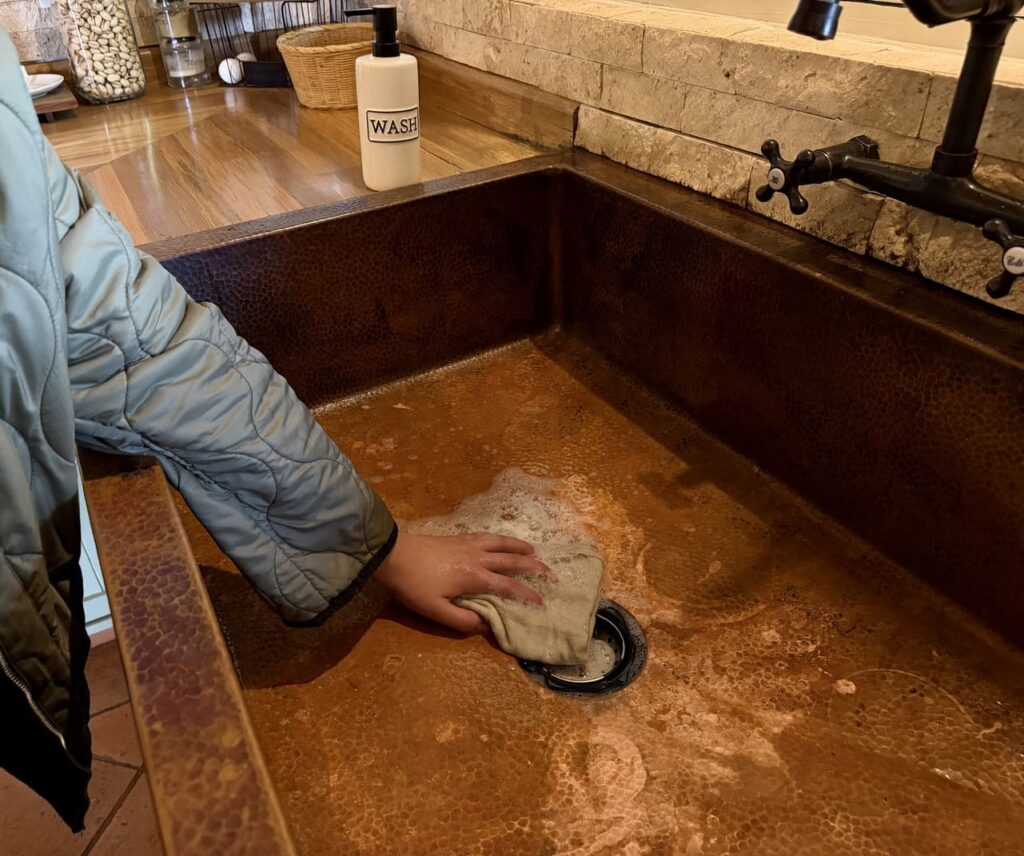
For regular cleaning, begin by rinsing the sink with warm water. This helps loosen food particles, oils and surface residue before any pressure is applied.
Add a small amount of mild dish soap to a soft sponge or cloth. Gently clean the basin, sides, apron front and areas around the drain. If the sink has a hammered texture, move carefully across the surface rather than pressing aggressively into every indentation.
Rinse thoroughly with clean water so that no soap remains on the copper.
After rinsing, dry the surface with a soft towel. Drying is not always essential for the material itself, but it can reduce visible water spots and mineral residue, particularly in areas with hard water.
The complete process is straightforward:
- Remove loose food and debris.
- Rinse with warm water.
- Apply mild soap with a soft cloth or sponge.
- Clean gently without abrasive pressure.
- Rinse the surface completely.
- Dry with a soft towel.
For a sink used daily, this simple routine is generally more appropriate than occasional heavy cleaning.
Consistency helps prevent residue from accumulating, while gentle products reduce the risk of unnecessarily disturbing the finish.
What Not to Use on a Copper Sink
The products that should be avoided are as important as the products that should be used.
Do not use steel wool, abrasive scouring pads or hard brushes on the surface. These materials can scratch the copper, disrupt a hammered finish or create bright areas that contrast strongly with the surrounding patina.
Avoid abrasive powders and highly aggressive cream cleansers. Even when they are marketed for kitchens, they may be too harsh for a living copper finish.
Bleach, ammonia and strong chemical cleaners should also be avoided unless the sink manufacturer has specifically approved them for the exact finish. These products may alter the patina, affect a protective layer or create uneven coloration.
Acidic cleaning methods require particular caution. Lemon juice, vinegar and similar substances are often recommended online as natural metal cleaners, but they can lighten copper rapidly. This may be useful when someone intentionally wants to remove oxidation from an unfinished copper object, but it is usually not the correct approach for preserving the patina of a handcrafted sink.
Products and tools to avoid include:
- Steel wool.
- Abrasive scrubbers.
- Scouring powders.
- Harsh degreasers.
- Bleach.
- Ammonia.
- Undiluted vinegar.
- Lemon-based cleaning treatments.
- Metal polish used without confirming finish compatibility.
A copper sink should not be treated like stainless steel. Methods designed to produce a completely bright and uniform surface can work against the qualities that make copper distinctive.
How to Handle Water Spots and Mineral Residue
Water spots are common on many kitchen surfaces, and copper is no exception.
They are often caused by minerals left behind after water evaporates. In areas with hard water, these marks may become more visible, especially on darker patinas.
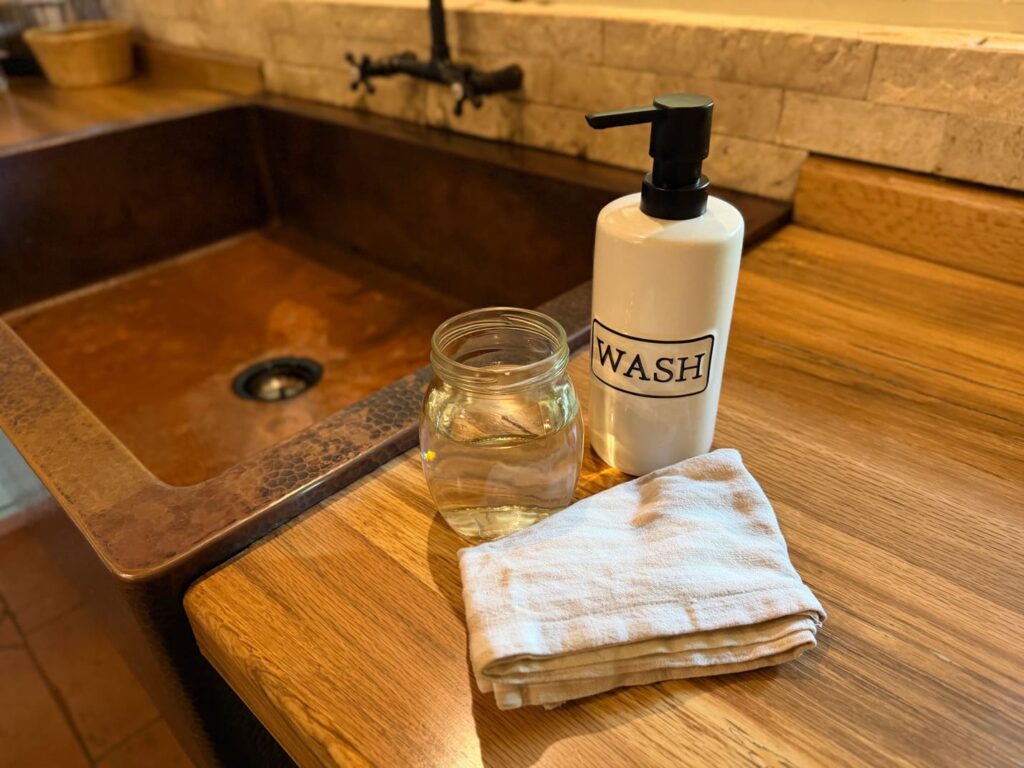
The first response should be gentle. Clean the area with warm water, mild soap and a soft cloth. Rinse it thoroughly and dry the surface.
If the mark remains, avoid immediately moving to vinegar or abrasive cleaning. First determine whether the appearance is actual mineral buildup, a temporary change in the patina or simply a difference in how light reflects across the hammered surface.
Drying the sink after heavy use can help reduce repeated spotting. It is not necessary to keep the sink perfectly dry at all times, but removing standing water and wiping the surface periodically can make the appearance more consistent.
For persistent mineral buildup, follow the care instructions associated with the specific finish. A sealed surface and an untreated living finish may not respond in the same way to corrective treatment.
What to Do When Acidic Foods Change the Patina
Lemon, tomato, vinegar, citrus juice, salt and other acidic or reactive substances can temporarily change the appearance of copper.
A lighter area may appear where the food or liquid touched the surface. On a dark patina, this contrast can initially feel dramatic.
This does not necessarily mean the sink has been permanently damaged.
On many living copper finishes, the exposed area will begin to darken again as it reacts with air, water and normal use. The new color may not return immediately or develop in exactly the same way as the surrounding surface, but the contrast often becomes less noticeable over time.
When an acidic substance comes into contact with the sink:
- Rinse the area promptly with water.
- Wash it gently with mild soap.
- Rinse again.
- Dry with a soft cloth.
- Allow the finish time to evolve naturally.
Avoid trying to correct the lighter area immediately with aggressive chemicals or darkening treatments. Attempts to force a quick match can create a larger or more uneven alteration.
Copper patina develops through gradual interaction with the environment. In many cases, patience produces a more natural result than intervention.
To understand why these variations occur, read The Beauty of a Living Finish: How Copper Patina Evolves Over Time.
Should You Polish a Copper Sink?
Polishing is not a routine requirement for every copper sink.
Traditional metal polish is designed to remove oxidation and restore brightness. On a decorative copper object intended to remain shiny, that may be appropriate. On a sink with a natural or intentionally darkened patina, polishing can remove the very finish that gives the piece its depth.
Before using polish, decide what result you actually want.
If the objective is to preserve a living finish, regular polishing is usually counterproductive. It may create a bright, reflective surface temporarily, but the copper will begin reacting with its environment again.
If the sink has a specialty finish, wax or sealant, confirm whether polishing is compatible with that treatment. Applying the wrong product can affect the finish unevenly.
Polishing should therefore be understood as an intentional refinishing decision, not as standard cleaning.
The same applies to homemade mixtures designed to make copper shine. A dramatic before-and-after result may look satisfying in a short demonstration, but it may not be appropriate for a handcrafted sink designed to develop a mature patina.
Preserving the Patina or Allowing It to Evolve
There is a difference between caring for a copper sink and trying to keep it visually unchanged.
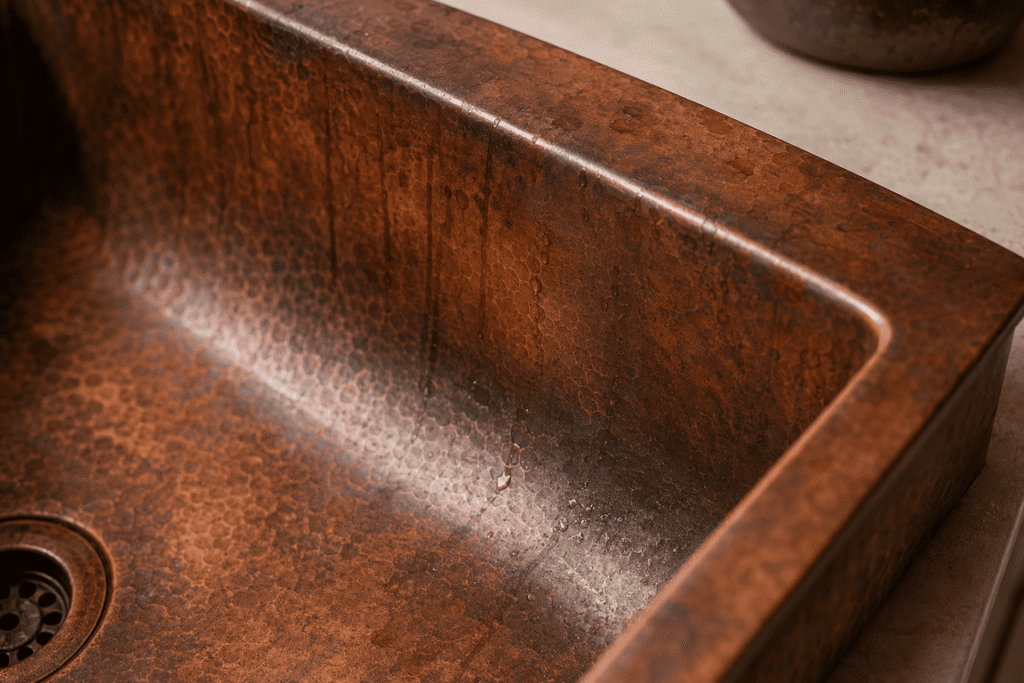
A living finish will continue to respond to daily life. Areas exposed to water may age differently from areas that remain dry. The basin may darken at a different rate than the apron front. Frequently touched edges may develop softer or brighter highlights.
These changes are not necessarily signs of neglect. They are part of the material’s behavior.
Homeowners who prefer a more consistent appearance can reduce abrupt changes by cleaning spills promptly, drying standing water and following the recommended maintenance routine. A suitable protective treatment may also help in some cases, depending on the finish and manufacturer recommendations.
Others may prefer to let the sink evolve with minimal intervention. In that approach, variations are accepted as part of the design rather than corrected every time they appear.
Neither choice is inherently wrong. The important thing is to begin with realistic expectations.
A copper sink will not behave like a synthetic surface engineered to look identical every day. Its appeal lies in the relationship between craftsmanship, use and time.
Monte Grande’s patinas and finishes can help illustrate the range of tones and surface characters available in handcrafted copper and brass.
Caring for the Drain, Edges and Hammered Texture
Certain parts of a copper sink may require more attention than the broad, open surfaces.
Food residue can collect around the drain, along corners or within the irregularities of a hammered texture. Use a soft cloth, soft sponge or gentle brush to clean these areas without scratching them.
Avoid leaving metal cans, wet sponges, cleaning tools or strongly colored containers sitting in the basin for long periods. Moisture trapped beneath an object can affect the surface differently from the surrounding area.
Rinse away soap thoroughly around the drain and fittings. Residue from cleaning products may create its own marks if it is allowed to dry repeatedly on the copper.
When cleaning around faucets, drains or hardware made from a different metal, consider the care requirements of both materials. A product that is safe for one finish may not be appropriate for another.
The objective is not to scrub every irregularity into uniformity. Hammer marks, tonal differences and subtle surface movement are part of the visual language of a handcrafted copper sink.
How Often Should a Copper Sink Be Cleaned?
A copper sink should be rinsed after regular kitchen use and cleaned with mild soap whenever food residue, oils or visible buildup are present.
For many households, a gentle daily wipe is sufficient. A more complete cleaning can be done as needed, depending on how frequently the sink is used.
It is better to clean lightly and consistently than to allow residue to accumulate and then rely on an aggressive product.
A practical routine may include:
- Rinsing after food preparation.
- Removing acidic residues promptly.
- Washing with mild soap at the end of the day.
- Drying the sink when water spots are a concern.
- Inspecting the drain and corners periodically.
- Avoiding prolonged contact with harsh substances.
Copper does not need to be treated as fragile. It simply benefits from care that respects its chemical and visual character.
A Material Designed to Change With Use
A handcrafted copper sink is both a functional kitchen element and a material surface that records daily life.
Its finish will interact with water, food, hands, cleaning routines and the atmosphere of the home. Over time, the sink may become darker, softer and more visually layered.
Proper cleaning does not prevent this evolution. It allows it to happen without unnecessary damage from abrasive tools or incompatible chemicals.
Warm water, mild soap and a soft cloth are often enough. More importantly, understanding the difference between dirt and natural patina helps prevent overcleaning.
The goal is not to erase every trace of use.
It is to keep the sink clean, functional and connected to the character of the material.
Explore Monte Grande’s copper kitchen sinks to discover handcrafted designs created for refined residential spaces, or review the Maintenance Guide for additional recommendations on caring for copper and brass pieces.
